In the world of amateur radio, clear communication is everything. When signals are weak, interference is high, or background noise threatens to garble a message, operators rely on a powerful tool: the phonetic alphabet.
Why Use the Phonetic Alphabet?
Some letters of the alphabet sound very similar, especially over a crackly radio transmission. Letters like “B” and “D” or “M” and “N” can be easily confused, leading to miscommunication. The phonetic alphabet eliminates this issue by assigning a unique word to each letter, ensuring clarity even in the noisiest environments.
For example, instead of saying “B as in boy,” an operator using the standardized phonetic alphabet would say “Bravo.” Similarly, “Delta” stands for “D,” and “Mike” stands for “M.”
The NATO Phonetic Alphabet: The Gold Standard
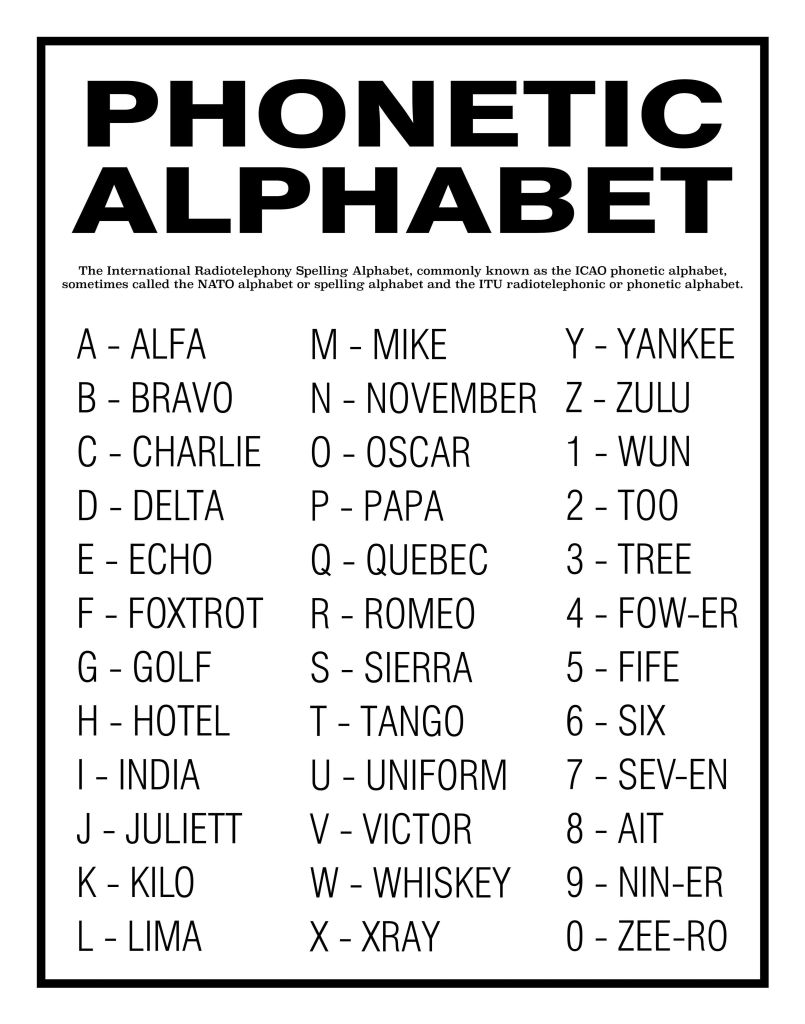
The most widely used phonetic alphabet today is the NATO version, first introduced in 1955. Since its inception, it has been adopted by various industries, including aviation, military, emergency services, and, of course, amateur radio enthusiasts.
Here’s a quick look at the NATO phonetic alphabet:
A – Alfa
B – Bravo
C – Charlie
D – Delta
E – Echo
F – Foxtrot
G – Golf
H – Hotel
I – India
J – Juliett
K – Kilo
L – Lima
M – Mike
N – November
O – Oscar
P – Papa
Q – Quebec
R – Romeo
S – Sierra
T – Tango
U – Uniform
V – Victor
W – Whiskey
X – X-ray
Y – Yankee
Z – Zulu
Phonetic Numbers
In addition to letters, the phonetic system also includes standardized pronunciations for numbers to further enhance clarity. Numbers are often distorted over radio transmissions, so these phonetic pronunciations reduce confusion:
0 – Zero (ZEE-ro)
1 – One (WUN)
2 – Two (TOO)
3 – Three (TREE)
4 – Four (FOW-er)
5 – Five (FIFE)
6 – Six (SIX)
7 – Seven (SEV-en)
8 – Eight (AIT)
9 – Nine (NIN-er)
The variations in pronunciation, such as “FIFE” for five and “NIN-er” for nine, help prevent confusion with similar-sounding words, making communication even more precise.
Why It Matters
Using a standardized phonetic alphabet improves accuracy and efficiency in radio communication. It prevents errors that could be costly in emergency situations and ensures that messages are understood correctly, no matter the conditions.
For amateur radio operators, mastering the phonetic alphabet is an essential skill. Whether calling out a call sign, relaying a location, or confirming details, this tool ensures that every message gets through loud and clear.
My issue with understanding the phonetic alphabet is more physical than not knowing because of hearing problems. Kilo foxtrot 8 charlie romeo sierra is a mouthful to say just for KF8CRS, especially trying to catch it over a busy noisey frequency. Phonetics is a lifesaver when learning and logging new callsigns.
Final Thoughts
The phonetic alphabet is more than just a list of words—it’s a universal language that keeps communication reliable and precise. So next time you’re tuning into a radio conversation, listen closely, and you just might hear “Tango Lima” instead of “T L.” That’s the power of phonetics in action!
73 and best wishes my friends.


Leave a Reply